None of 445 free rigged characters play UE5 Manny animations as they are
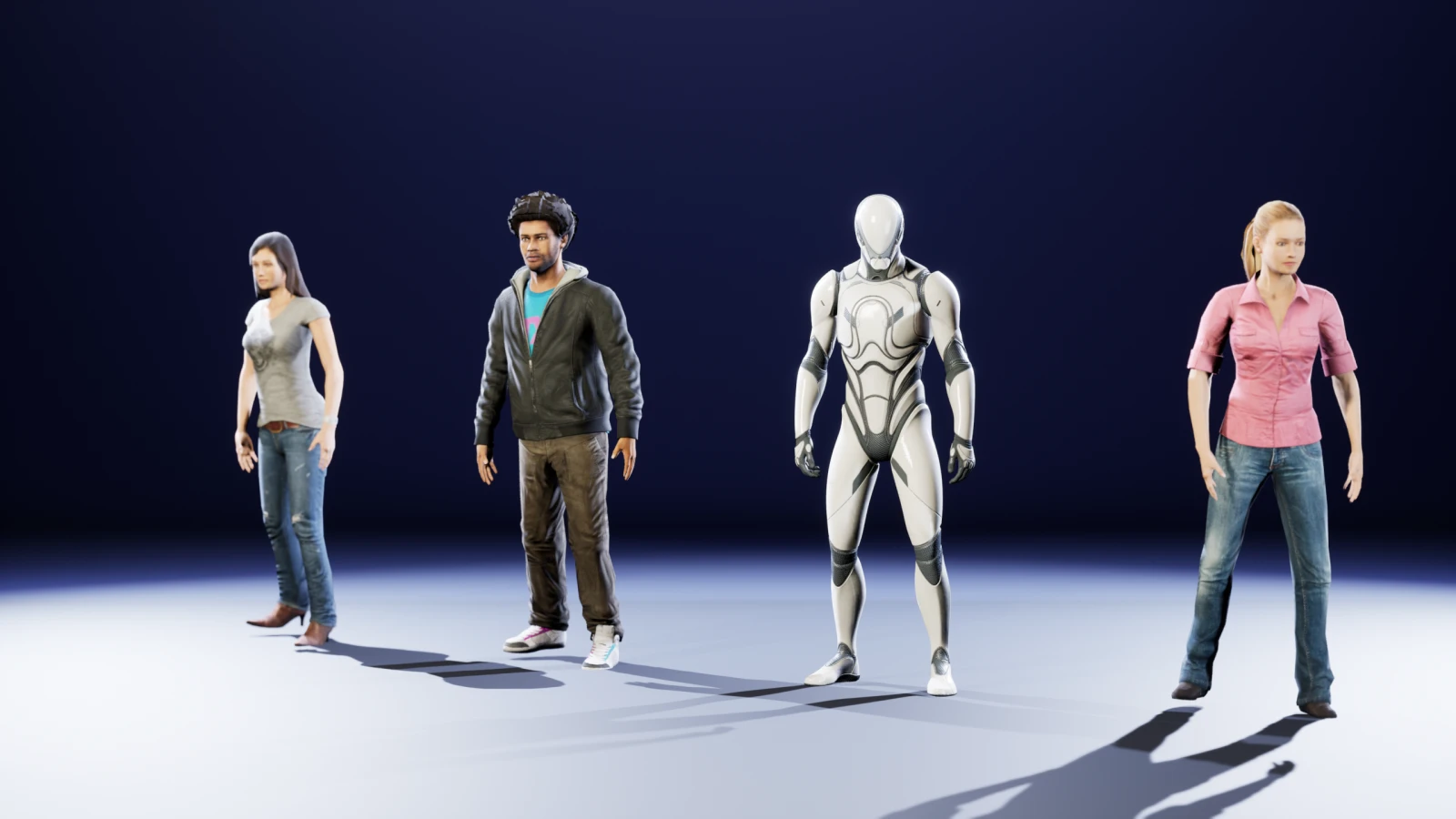
You found a free rigged character, imported it into Unreal Engine 5 and tried one of the Manny animations on it. It did not play, or the arms bent the wrong way. We wanted to know how often that happens, so we read the skeletons of 445 free, openly licensed rigged characters and compared each one with the UE5 Manny skeleton.
This post is what we learned and what to do with your own character. The full tables, the method and the counts by source are on the study page, and every number below is in its aggregate CSV.
How we read 445 characters
- We listed 593 files from 7 sources whose licences are CC0, CC-BY or MIT, and downloaded them one batch at a time.
- Blender 5.0.1 opened every file headless and recorded each bone's name, parent and rest position, and the size of the skinned mesh.
- The bone names went through the same matching code as our free UE5 Skeleton Checker, and every character it sent to re-rig was then looked at by hand.
- Colour variants of one character count once, so 447 rigged files became 445 characters on 106 distinct skeletons.
- Files we could not download or read (144) and files with no skeleton (2) are left out of every percentage.
Names, not weights: why 442 only need a rename
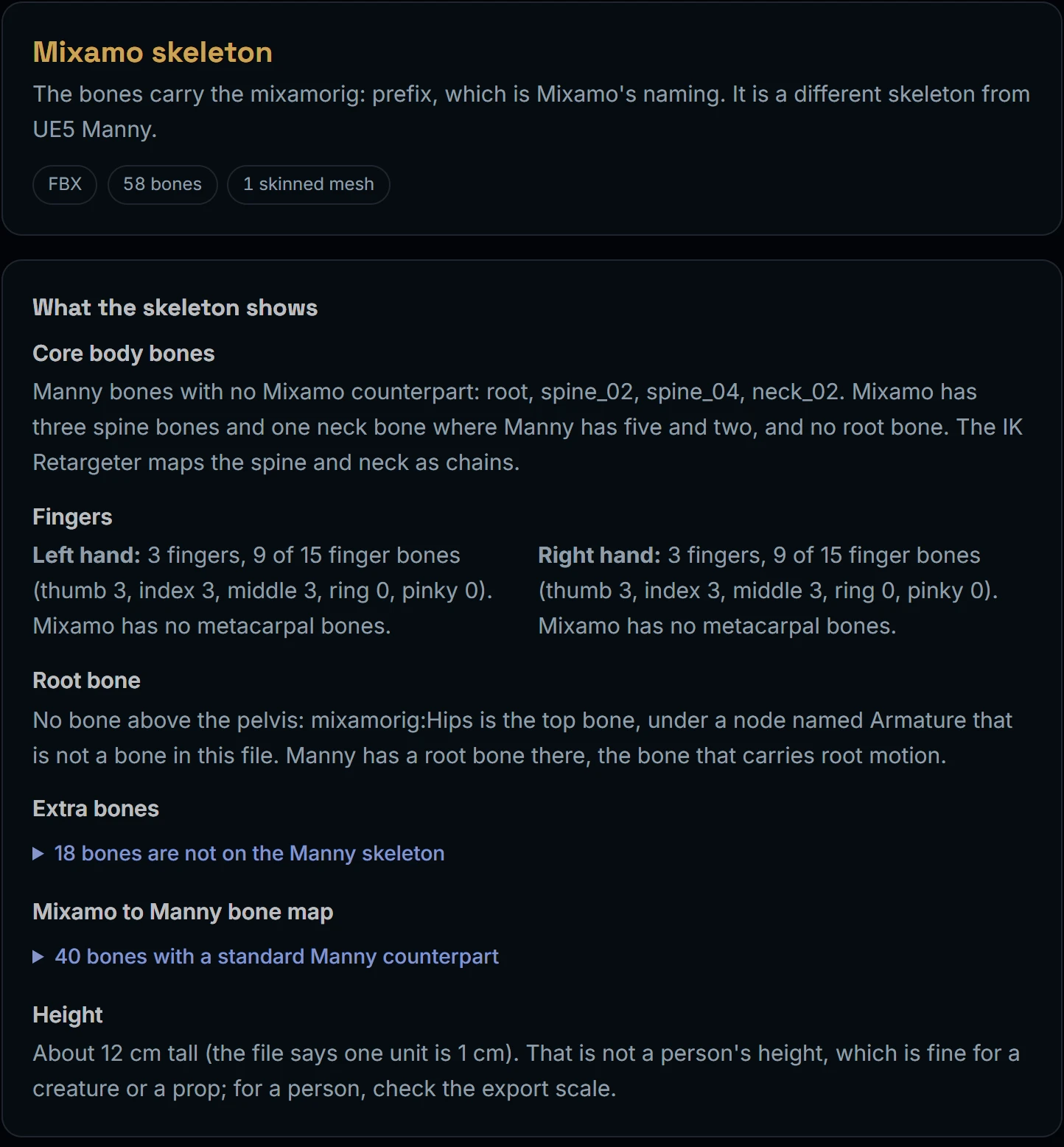
A Manny animation is made for Manny's skeleton. It plays on another character as it is only when that character has Manny's bone names (pelvis, spine_01, upperarm_l and so on) in Manny's hierarchy, with a bone named root on top. Not one character in the sample does. 315 use Mixamo names, 115 use 3ds Max Biped names, 1 uses Blender Rigify names and 14 use names of their own.
The useful number is the second one. 442 of the 445 characters (99%) have all 15 body bones that VRM 1.0 requires for a humanoid (hips, spine, head, and both upper arms, forearms, hands, thighs, shins and feet), in the right parent order, under other names. Nobody has to paint new skin weights for them. For 5 of them no automatic map knew the names (joint numbers, or a typo such as RightUpLeg1), so we matched those by hand.
Only 3 characters miss a body bone, such as the hands or the forearms, and need a re-rig.
What each character needs before Manny animations play
445 characters. A rename keeps the skin weights; 312 of the 442 also need a root bone added.
The numbers as a table
| Group | Characters | Share |
|---|---|---|
| Plays Manny animations as it is | 0 | 0% |
| Needs a rename, no new weights | 442 | 99% |
| Needs a re-rig | 3 | 1% |
"Rename only" is not zero work. We compared names and the hierarchy, not bone orientations. Two skeletons with the same names can still point their bones differently, and then a Manny animation looks wrong until it goes through the IK Retargeter.
The missing root bone and root motion
Manny's pelvis hangs under a bone named root. Root motion lives on that bone: the forward travel of a walk or a jump that moves the character, not only the mesh. Only 10 of the 445 characters (2%) have a bone named root above the pelvis. In 310 the pelvis is the top bone, 121 have another bone above it (3ds Max Biped's Bip01, for example) and in 4 we found no pelvis.
So most renames come with one more step: 312 of the 442 rename-only characters need a root bone added above the pelvis. Unreal's IK Retargeter asks you to mark the pelvis for the same reason:
"In addition to defining chains, you must also define the pelvis bone. This is done so the character's root motion can be defined and transferred in a proportional way."
- For a Mixamo character, the free Mixamo to UE5 converter renames the bones to Manny's names and adds a bone named root at the origin, in your browser. If you tick the option, it also moves each clip's travel along the ground from the pelvis to root.
- For other skeletons, add the root bone in your 3D tool before export, then check it again in the skeleton checker.
Scale: 191 characters under 50 cm
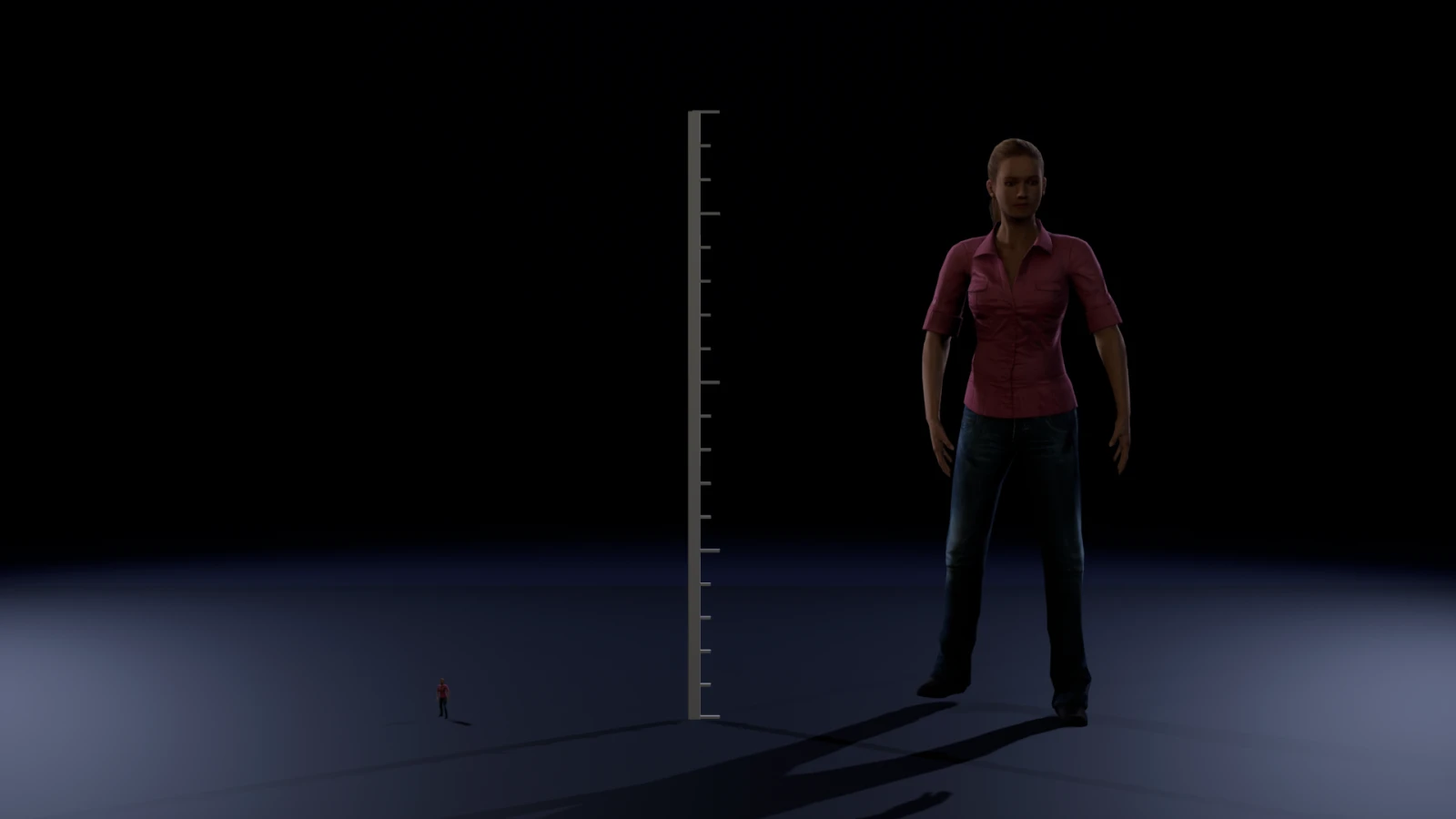
We measured each skinned mesh from its lowest to its highest point, after Blender applied the file's own unit. 218 characters (49%) stand between 120 and 220 cm, close to Manny's 179 cm. 191 (43%) would arrive under 50 cm, 29 between 50 and 120 cm, and 7 between 220 cm and 10 m.
Some stylised characters are small on purpose. A human under 50 cm, though, usually means a unit mismatch: centimetres written as metres, or the other way round. Fix the scale before you judge an animation, because a retarget onto a tiny character can look broken when only the size is wrong. The skeleton checker reports the height and says when the units look off.
The up axis did not decide anything: all 445 characters were saved Y up, and Unreal's importers convert it.
Height at import
445 characters, measured on the skinned mesh. Manny is 179 cm.
The numbers as a table
| Group | Characters | Share |
|---|---|---|
| Under 50 cm | 191 | 43% |
| 50 to 120 cm | 29 | 7% |
| 120 to 220 cm (human size) | 218 | 49% |
| 220 cm to 10 m | 7 | 2% |
T pose against Manny's A pose
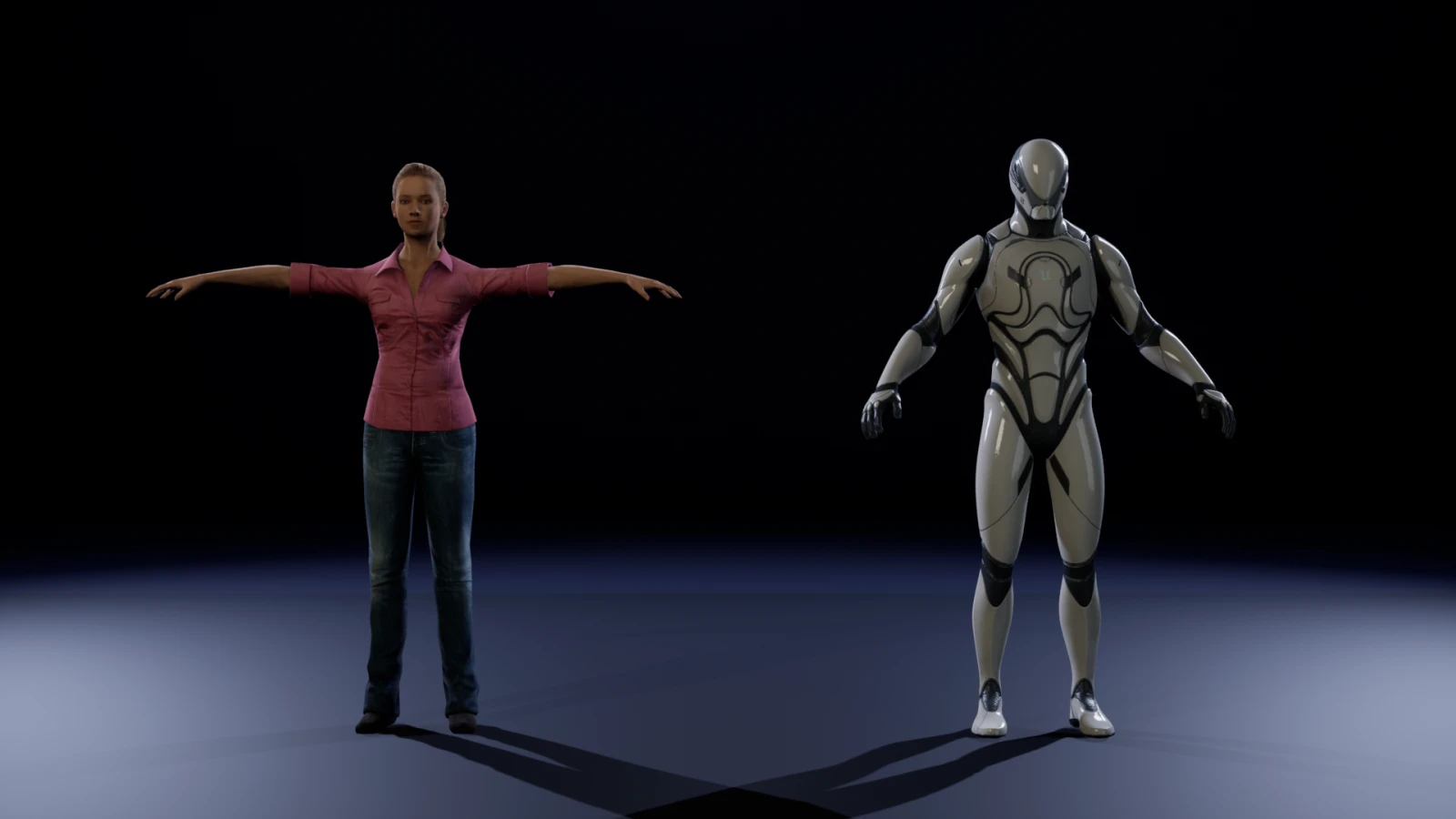
Manny rests in an A pose, with the upper arms about 55 degrees below horizontal. 294 characters (66%) rest in a T pose (arms under 20 degrees), 147 (33%) in an A pose, and 4 had no arm bones to measure.
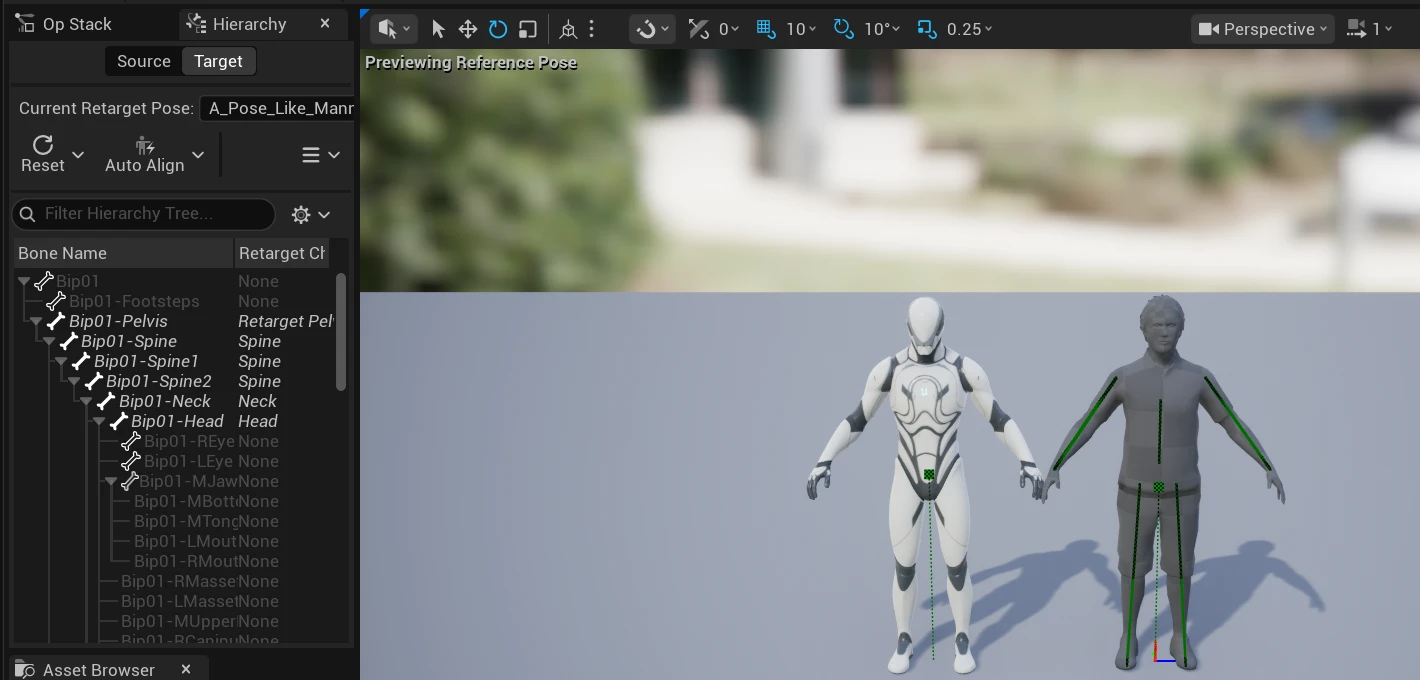
A T pose character gets the difference in arm angle in every frame unless the retarget corrects it. Epic's documentation names this exact case:
"Typically you need to do this if your target character's reference pose is different from the source, such as being in a T-pose, rather than an A-pose. Matching these retarget poses increases the accuracy of the retargeting."
- In the IK Retargeter, make a new retarget pose for the T pose character and lower its arms until they match Manny's.
- Check a walk and an idle before anything else: those show a wrong arm angle at once.
No twist bones
Manny has 16 twist bones: two each on the upper arm, forearm, thigh and calf, on both sides. They spread a turn of the hand or the foot along the limb. None of the 445 characters have any.
A retarget can still map the arm and leg chains without them, so this does not stop an animation from playing. What you lose is the spread: a strong turn of the hand lands on one joint, and the wrist can pinch. Adding twist bones means new skin weights, which is re-rig work, not a rename.
Fingers are in better shape: 272 characters (61%) have bones for all five fingers on both hands, 154 have some finger bones and 19 have none. Manny animates 15 finger bones per hand.
What to do with your free character
Start with the free UE5 Skeleton Checker. It reads your FBX or GLB in the browser, without an upload, and tells you the naming convention, which body bones are missing and what sits above the pelvis. Then find your row.
| What the checker shows | What to do | Free tool or guide |
|---|---|---|
| Mixamo names (315 of 445 in our sample) | Rename the bones to Manny's names and add a root bone. Then retarget in Unreal to fix the pose and bone directions. | Mixamo to UE5 converter, and the Mixamo bone names guide for the full name map |
| 3ds Max Biped, Rigify or own names (130) | Keep the rig. In Unreal, make an IK Rig for it, map its chains to Manny's, set a retarget pose and retarget the animations you need. | The UE5 Manny skeleton guide (bone by bone) and the IK Retargeter guide |
| Missing body bones (3), or no rig at all | Rig the mesh again. Check the unrigged GLB first: size, scale, pose and loose parts. | Rig-ready checker |
| You want Manny animations with no retarget step | Rig the mesh onto the Manny skeleton itself. RigMaster, one of the Cosindra workspaces, does that from joint markers you place: a skin with Mixamo or UE5 bone names is carried over onto Manny's bones, and any other gets new weights. | Rig-ready checker first, then RigMaster |
Free route or re-rig? A rename and a retarget keep the artist's weights and cost nothing, which suits a character that needs a handful of animations. A re-rig onto Manny is more work up front, and then every animation made for the Manny skeleton plays on the character as it is.
Limits of this post
- Names and hierarchy only. We did not compare bone orientations, rolls or skin weights, so "rename only" means no new weights and at most a root bone added, not zero work.
- The sample leans on two libraries: Rocketbox and 100Avatars make up 414 of the 445 characters (93%), and each builds its characters on one family of skeletons. The study page shows each source on its own.
- Blender read the files, not Unreal. Unreal's FBX importer can treat a few nodes differently; for example, it keeps a Biped skeleton root such as Bip01 as a bone.
- Free and openly licensed characters only. Paid packs and characters made for Unreal on purpose may look very different.
- The table of what to do is advice from how these tools work. We did not run every route on all of the characters.
Sources
- Microsoft Rocketbox, LICENSE.md (MIT). Read on 6 November 2026.
- Open Source Avatars registry, projects.json (CC0 for 100Avatars R1 to R3 and the community collections we read). Read on 6 November 2026.
- Kenney support page: "all game assets on the asset pages are public domain licensed (CC0)". Read on 6 November 2026.
- KayKit Adventurers 1.0, LICENSE.txt (CC0). Read on 6 November 2026.
- KayKit Skeletons 1.0, LICENSE.txt (CC0). Read on 6 November 2026.
- Khronos glTF Sample Assets, CesiumMan (CC BY 4.0). Read on 6 November 2026.
- Khronos glTF Sample Assets, RiggedFigure (CC BY 4.0). Read on 6 November 2026.
- Epic Games, IK Rig Animation Retargeting in Unreal Engine (UE 5.8 documentation). Read on 6 November 2026.
- Visuals: Microsoft Rocketbox Male_Adult_01, MIT. Read on 7 November 2026.
- Visuals: Microsoft Rocketbox Male_Adult_04, MIT. Read on 7 November 2026.
- Visuals: Microsoft Rocketbox Female_Adult_01, MIT. Read on 7 November 2026.
- Visuals: Microsoft Rocketbox Female_Adult_08, MIT. Read on 7 November 2026.
- Visuals: 100Avatars R1 in the Open Source Avatars registry (#031 Devil, by Polygonal Mind), CC0. Read on 6 November 2026.
- Visuals: Unreal Engine EULA, which covers Manny and the walk from the Third Person template. Read on 6 November 2026.
Updates
- : First published.