Building a GTA 6 style open world in Unreal Engine 5: what a small team can make
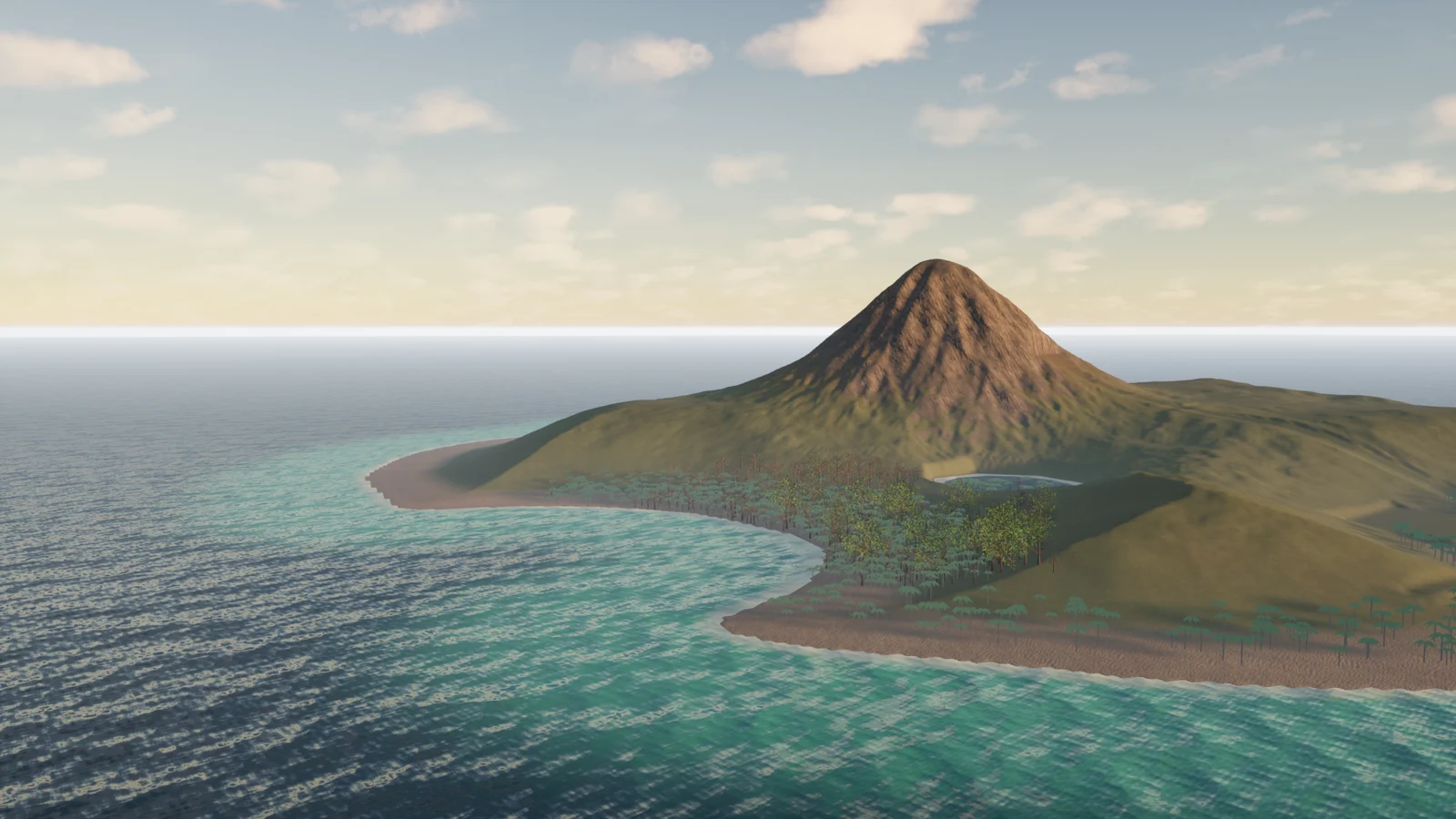
GTA 6 comes out this week, and many small teams will play it and wonder which part of a game like that they could build themselves. This post is our answer for Unreal Engine 5, written for developers rather than players.
We built one slice on 17 November to find out: a 2 km tropical coast with a river, a beach road and a village blockout, taken from a template to a lit Unreal Landscape. Every picture below is ours, and every number is one we measured, one from the template itself or one of our published prices.
What Rockstar has officially shown
Rockstar Games lists Grand Theft Auto VI for 19 November 2026 on PlayStation 5 and Xbox Series X|S, on the official game page. The same page names the two leads, Jason and Lucia, and sets the story in Vice City and across the state of Leonida. A Rockstar Newswire post repeats the 19 November launch on both consoles.
That is all we repeat here. The map size, the budget, the size of the team, the engine and a PC date are not on those official pages, so they are not in this post either.
Build a slice, not a copy
A game of that kind is many games at once: driving, shooting, a long story, crowds, radio, shops, police and a city with rooms you can enter. A small team cannot build all of it, and does not need to. What you can build is a slice: one small place, a few things to do in it, and only the systems those things need, finished well enough that someone wants to stay.
A slice also tells you what your world costs before you commit to it. You learn how long a street takes to dress, how many people your frame budget can carry and where streaming stutters, on a map you can still change in an afternoon.
- Ground: a coast and a beach, a river with a delta, a lake, hills and one peak.
- A place: a village blockout of plain boxes on a flat pad, and a beach road.
- Movement: a player who walks, jogs and idles, and a few people who do the same.
- Left out on purpose: cars, combat, interiors, missions and a city.
Make it your own world, with your own names, streets, characters and story. A slice that copies another game's map, characters or branding is something you can never ship.
The slice: a 2 km coast from a template
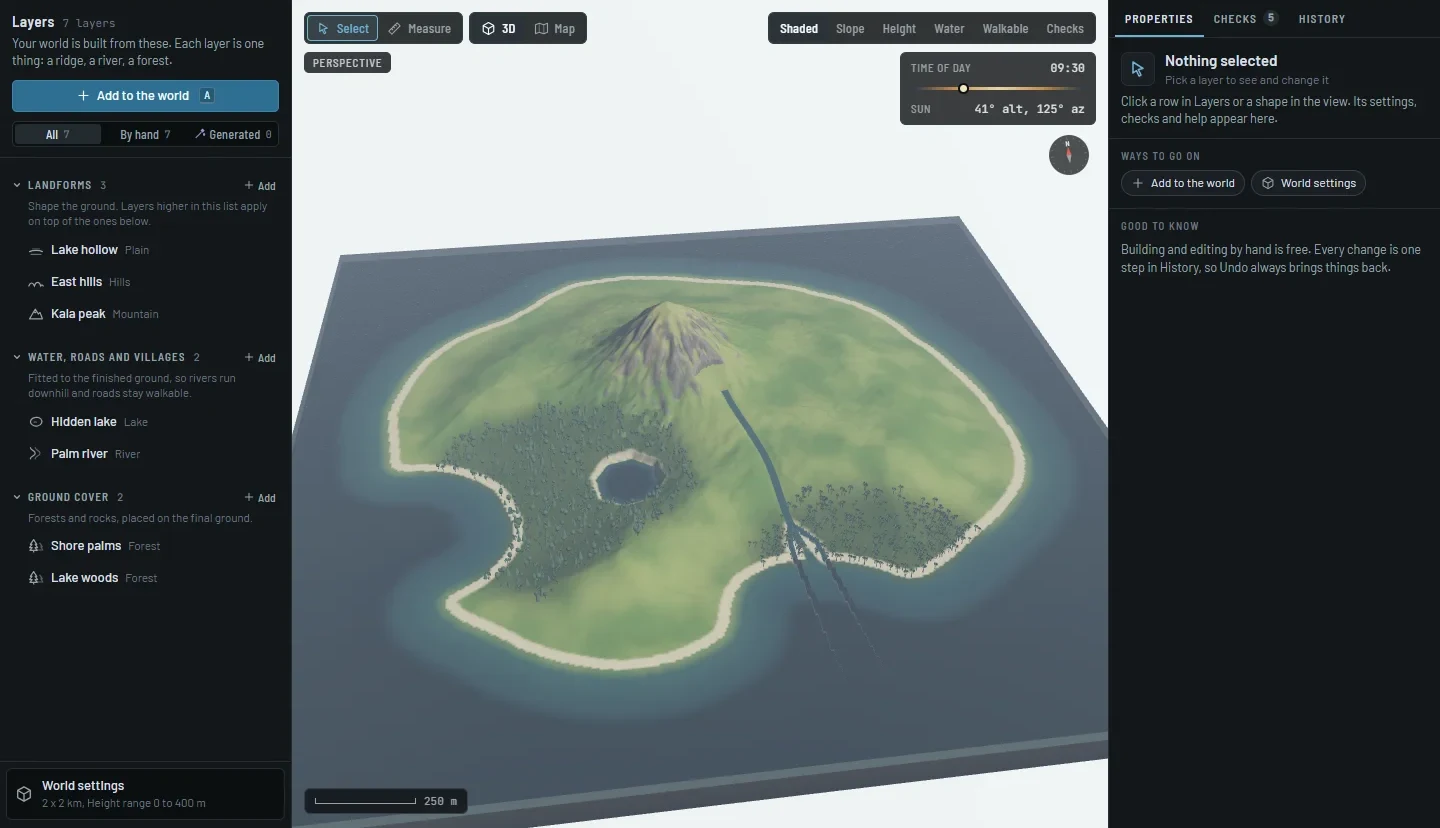
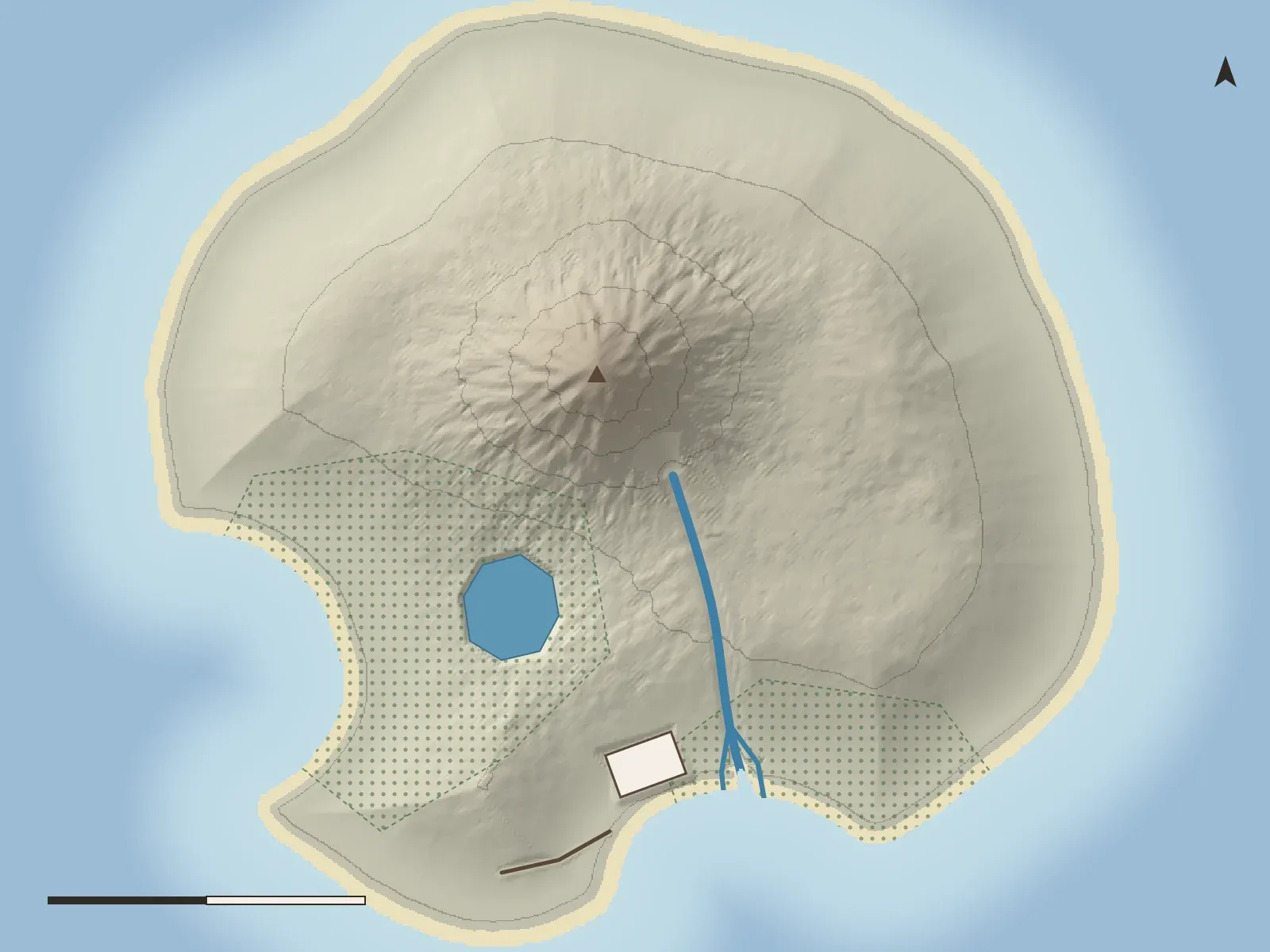
We started in WorldWeaver Studio, from its Tropical island template at 2 km with heights from 0 to 400 m. The template brings an island coast with the sea at 48 m and a 24 m beach, a peak, hills to the east, a lake in a hollow, a 14 m wide river that splits into 3 arms at the sea, palms along the shore and mixed woods by the lake.
The template has no town, so we added two layers: a village pad of 110 by 70 m on the flat ground west of the river mouth, and a beach road of about 190 m. WorldWeaver checks every layer for slope, earthwork and water. Our first places for the village and the road failed those checks (too much earthwork, a road too steep or running into the sea), and it took several tries to find a spot where every check passed.
From World Pack to Unreal Landscape
We exported the Unreal World Pack at 1K: a 1009 by 1009 16-bit heightmap with its import values, masks for slope, height, water and walkable ground, a density mask per forest, starter ground surfaces and the install scripts.
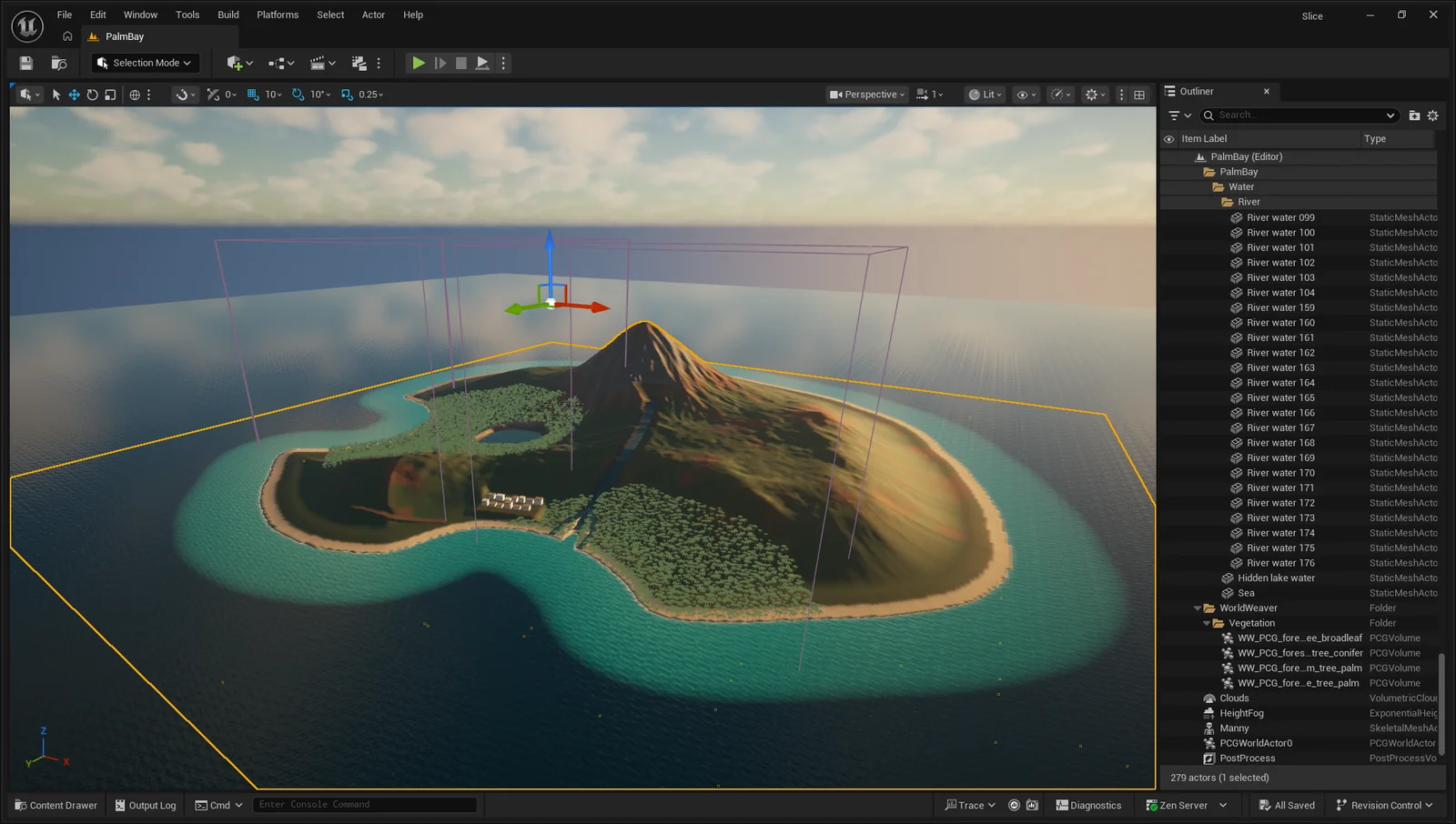
In Unreal Engine 5.7 we made a new level and ran the pack's install_landscape_layers.py. With the Cosindra Unreal plugin in the project (it installs with the Cosindra desktop app), the script creates the Landscape itself, with two edit layers (WorldWeaver for the pack's heights, My edits for yours), and builds one PCG graph and volume per forest. Without the plugin you import heightmap.png in Landscape Mode with the scale from the pack's README (198.41, 198.41 and 78.12 for this map), then run the same script.
The sea, the river surface, the landscape material, the village blocks, the sky and the camera were our own work on top, and they took far longer than the import. For a map that grows past one slice, Epic's World Partition is the system that keeps it streamable:
"World Partition is an automatic data management and distance-based level streaming system that provides a complete solution for large world management."
- Template to Unreal World Pack: 7.0 s in each of three runs. This is compute time only: we ran WorldWeaver's export on our own Windows test PC, so no upload or download is in it.
- World Pack to Landscape: the install script took 17.7 s on its first run in Unreal Engine 5.7.4, and about 6 s on later runs, to create the 1009 by 1009 Landscape and the four tree graphs, on the same PC with integrated graphics.
- Trees: generating the four graphs placed 7,602 trees at the densities the pack asks for. On the first pass, while the editor was still compiling the density masks, the volumes came up empty; pressing Generate again on each one filled them.
Movement: the player, the people and your own character
- The player: Epic's Game Animation Sample is free on Fab. It shows motion matching locomotion and traversal on a third person character, and Epic's page for it calls it a project to learn from and build on. Plan time to move its systems into your own project.
- The people: walks, jogs and idles from the free animation library, all on the UE5 Manny skeleton. The best take of every gallery motion downloads free with any account, in every format. They are clips, not a crowd system: you still need a controller, a navmesh and something that picks the clip.
- Your own character: if it is not on the Manny skeleton, those clips will not play on it as they are. Retarget them with the IK Retargeter, or put the character on Manny with RigMaster, one of the Cosindra workspaces (a rig costs 15 credits). Our first post counts how often free characters need that step.
Cars and traffic
We did not build cars for this slice, and Cosindra does not make vehicles. Unreal's own system is Chaos Vehicles, which Epic's documentation calls its lightweight system for vehicle physics. Traffic that drives itself is a large project of its own; for a first slice, one car you can drive along the beach road is a fair goal.
What you need, a free route and where Cosindra fits
| What you need | A free route | Where Cosindra fits |
|---|---|---|
| Terrain | Sculpt in Landscape Mode, or import a heightmap you made (Epic's heightmap guide). | WorldWeaver. Free to start, no card. Building by hand in Studio is free on every plan. Your own worlds export free at 1K. A world made from a written brief costs 6 credits. |
| Ground materials | The starter surfaces in the World Pack (grass, soil, rock, sand and wet sediment), or materials you make. | MaterialForge makes a material from a description for 4 credits, and adjusting its parameters afterwards is free. |
| Characters | Manny and Quinn from the Unreal templates, or openly licensed characters (read each licence). | RigMaster puts your own character on the Manny skeleton for 15 credits a rig. |
| Animation | Epic's Game Animation Sample, free on Fab. | Free animation library on Manny. A new motion from a prompt costs 5 credits for 4 takes. |
| Vehicles | Chaos Vehicles in Unreal Engine. | Nothing. We do not make vehicles. |
| Store page | Steam's graphical assets guide and our free Steam Capsule Checker. | LaunchKit grades a store page and lists fixes for 3 credits an analysis. |
Limits of this post
- A 2 km slice is not a city. It has no interiors, no traffic, no crowds and no missions, and each of those is a project of its own.
- The village is plain boxes on a flat pad. WorldWeaver gives you the pad and the road; the buildings are yours to make.
- Our timings come from one Windows test PC with integrated graphics and one map. Yours will differ, and a larger map or a 2K export takes longer.
- The cover uses WorldWeaver's realistic oaks and ashes, which are still in preview. For this cover we used the simple starter palm and placed extra palms along the beach in view. The editor screenshot shows the simple starter trees.
- The slice is one plain level. In our World Partition test level the pack's tree graphs placed no trees, so we did not use World Partition for the pictures; the Landscape itself imported the same way in both.
Not affiliated with Rockstar Games or Take-Two Interactive. Grand Theft Auto is a trademark of Take-Two Interactive.
Sources
- Rockstar Games, Grand Theft Auto VI official page (release date, platforms, Jason and Lucia, Vice City, Leonida). Read on 17 November 2026.
- Rockstar Newswire, Grand Theft Auto VI Pre-Load Begins on November 10 (launch on 19 November on PlayStation 5 and Xbox Series X|S). Read on 17 November 2026.
- Epic Games, World Partition in Unreal Engine. Read on 17 November 2026.
- Epic Games, Importing and Exporting Landscape Heightmaps in Unreal Engine. Read on 17 November 2026.
- Epic Games, Game Animation Sample Project in Unreal Engine. Read on 17 November 2026.
- Fab, Game Animation Sample (listed free). Read on 17 November 2026.
- Epic Games, Chaos Vehicles. Read on 17 November 2026.
- Steamworks Documentation, Graphical Assets. Read on 17 November 2026.
- Visuals: Unreal Engine EULA, which covers Manny and his walk from the Third Person template. Read on 6 November 2026.
- Visuals: Kenney Nature Kit (CC0), the source of the World Pack's starter conifer. Read on 17 November 2026.
- Visuals: EZ-Tree by Daniel Greenheck (MIT), which generated the oak and ash models of the realistic trees. Read on 17 November 2026.
- Visuals: ambientCG licence (CC0), the source of the realistic trees' bark photographs. Read on 17 November 2026.
- Visuals: Poly Haven licence (CC0), the source of the cover's rock, cliff, dry grass and beach textures. Read on 18 November 2026.
- Visuals: ambientCG Grass004 (CC0), the cover's green grass texture. Read on 18 November 2026.
Updates
- : First published.