Cosindra MaterialForge makes PBR materials for your game from a prompt, a photo or your own model: texture maps and an Unreal material recipe for UE5, or maps with an OpenGL normal map for Unity, Godot and Blender.
Not affiliated with other products named Material Forge.
MaterialForge · Unreal Engine 5.7 to 5.8
AI materials for Unreal Engine. One surface or a whole pack.
Turn a surface brief, or your own texture photo, into PBR textures and an Unreal material recipe. Compare alternatives, adjust exposed parameters and bring the materials you choose into your project through Cosindra.
Describe one material in as much detail as you need. A long prompt still produces one material.
Example brief
“A colorful road-playmat printed on soft woven carpet, with roads, houses and gardens. Top-down, seamless, no baked lighting.”
One patterned carpet material, not separate road, house and grass materials.
Variations
Paid plans
2 or 4 materials
Explore the same idea.
Generate alternative takes on one brief, then compare their surface details in the live preview.
Example brief
“Rusty sci-fi metal panels with scratches, dark paint and orange corrosion.”
Different takes on the same metal-panel brief.
Material Pack
Paid plans
2 to 8 materials
Build a set of surfaces.
Use a shared batch brief for different materials, or write a separate prompt card for each surface.
Example brief
“An abandoned research station needs corroded steel wall panels, cracked concrete floors and worn rubber walkway mats.”
Review the proposed steel, concrete and rubber briefs, edit them, then generate. Numbering is optional.
From image
Paid plans
1 material
Already have the texture? Make it a material.
Upload a flat photo or scan of one surface and choose the square to use. It becomes the Base Color; MaterialForge adds Normal, Roughness, AO, Metallic and Height maps made for that surface type and writes the Unreal material.
Example image
A head-on phone photo of a mossy cobblestone street, evenly lit, with no sky or horizon.
1 credit per material, or 2 with deep relief maps. Lighting, shadows and perspective in the photo stay as they are.
Repaint with a prompt
All plans · first repaint free
Your own .glb
Give your model a new look from one sentence.
Open Paint a model in the product bar, open your model and describe the look. MaterialForge repaints the base colour of the whole model or only the parts you choose, consistent from every side, removes baked lighting, and can make new normal and roughness maps for the repainted parts. 14 flat views of the model are repainted, plus the repainted textures when you ask for new maps; a model that is not saved is kept as a private copy for 24 hours with the repaint, unless you save it.
Your first repaint is free, new maps included; after that 4 credits, or 8 with new normal and roughness maps, refunded if it does not line up with your model. HD paints each part at up to 2K instead of 1K for 3 more credits, also on the free repaint. Adjust roughness, metallic and tint in the Surface tab, then save the look or download the GLB.
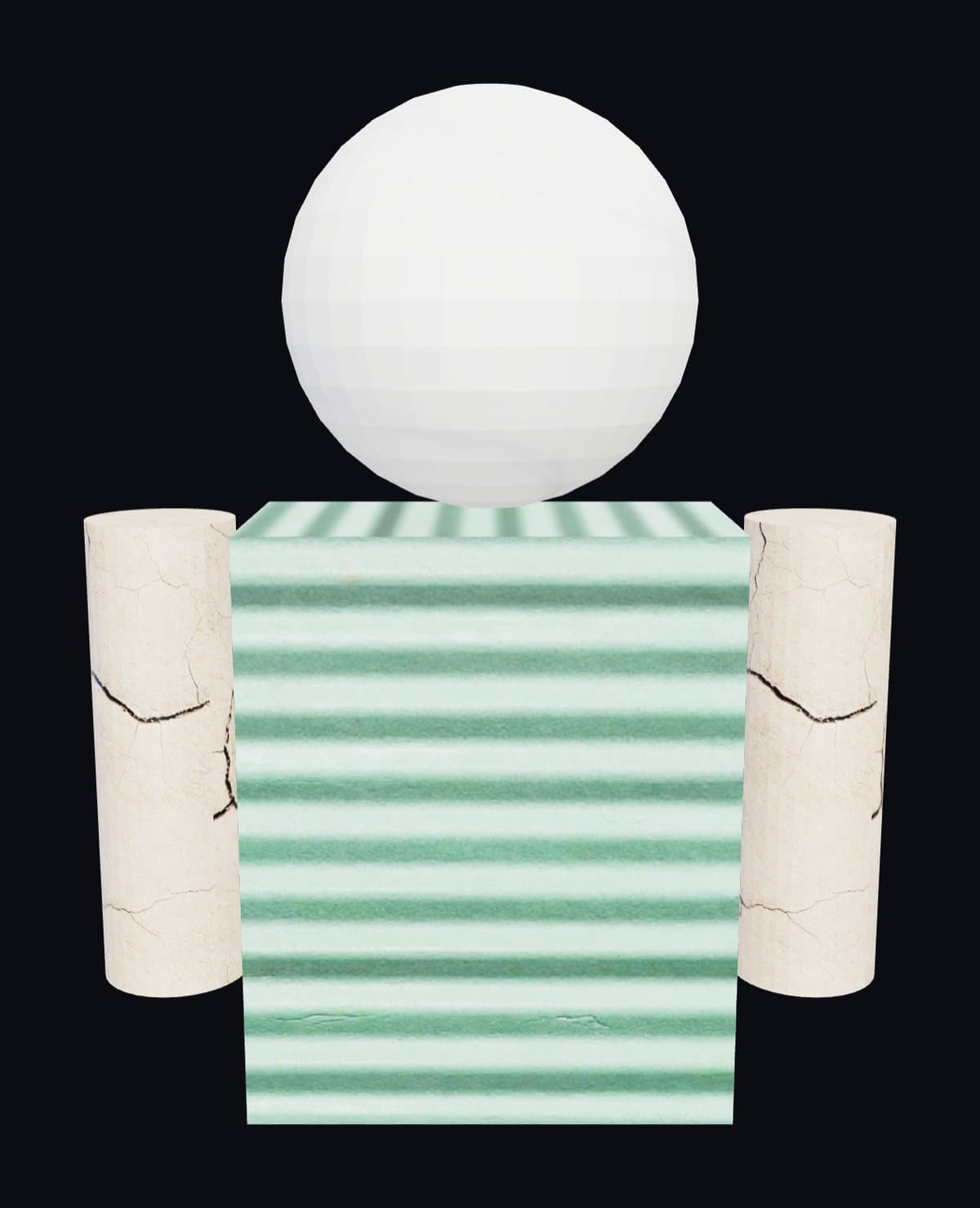
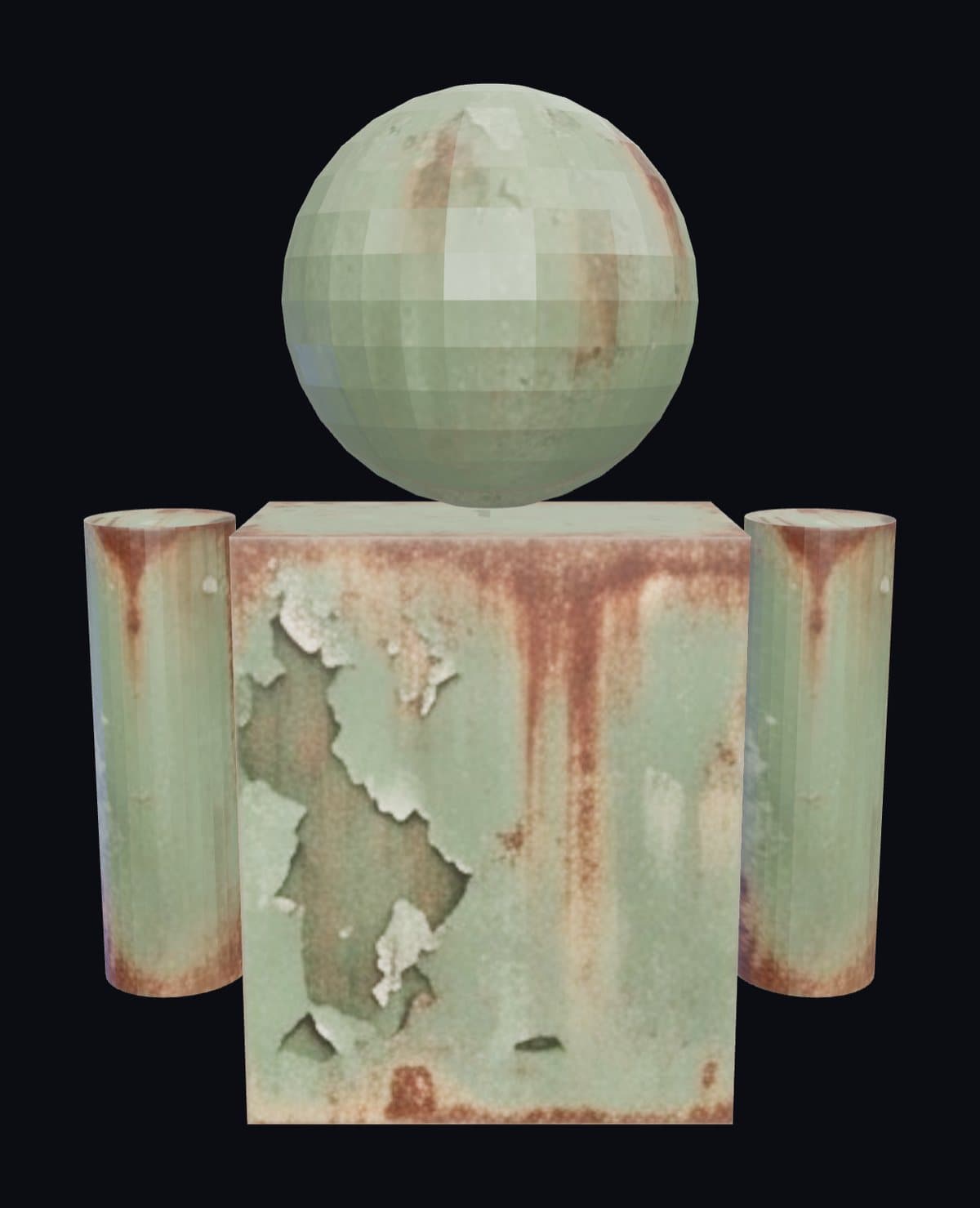
The prompt “weathered steel with peeling military-green paint, scratches and rust streaks”One result, as it came back; the same views, before and after.
In the Repaint tab
8 credits with these options. Your first repaint is free, maps included; HD adds 3 credits even then.
Materials are not maps. Each textured result has Base Color, Normal, Roughness and AO maps, and new results also have Metallic and Height maps. A pack is a set of separate materials; procedural recipes may not need texture maps at all.
Inspect and compare
View the selected material on a sphere, cube or plane. Compare your results before choosing which ones belong in your project.
Adjust without a new render
Change exposed recipe parameters for free. For a new visual direction, Refine uses your instruction in a fresh, paid generation.
Keep it. Use it.
Save each chosen material to your private library. Download the successful pack results together, or apply them through the desktop app and UE plugin.
Before you generate
Does a long prompt automatically create a Material Pack?
No. You choose Single, Variations or Material Pack. In Material Pack, Prepare material list turns a scene brief into a proposed list to review and edit before generating. Numbering is optional; Separate cards also lets you write exact briefs yourself. A detailed description of one printed carpet is still one material. Lists are not padded to fill a count; packs support up to eight distinct materials. Ready results become selectable while the remaining materials generate.
Are four PBR maps the same as four materials?
No. One textured material includes Base Color, Normal, Roughness and Ambient Occlusion (AO) maps, plus its Unreal material recipe; new materials also include Metallic and Height maps. A four-material pack contains four separate results, each with its own recipe and maps where needed. Procedural results can be recipe-only.
How are the PBR maps made?
New textured materials include six maps: Base Color, Normal, Roughness, AO, Metallic and Height. Older materials may have only the first four. Standard renders a tileable Base Color, then derives Normal, Roughness, AO and Height for the kind of surface you described: a printed design such as a road playmat stays flat colour, bricks and tiles keep their mortar recessed, and roughness follows the finish your brief asks for. Pro Engine adds a deep relief pass (an estimated normal map and height-based AO) for deeper relief on stone, brick, wood and cracked ground. Metallic follows the material: metal surfaces get a per-pixel metallic map, estimated from the colours of the surface, or the material's metallic value when that cannot be estimated, and anything else gets an all-black one. Pro Engine renders all six maps at 2048x2048 (2K); Standard renders them at 1024x1024. Pro 4K is the 2K render upscaled to 4096x4096, all six maps, for 13 credits; the upscaled maps still tile. Normal maps use the DirectX convention Unreal expects. Apply in UE5 imports Base Color, Normal, Roughness and AO and keeps metallic as a value in the material; Metallic and Height are in the download whenever the material has them. For Pro 4K, Apply in UE5 imports the 2K maps for now, and the ZIP downloads carry the 4K maps.
Does MaterialForge use AI?
Yes, in named steps. From a prompt, a language model writes the Unreal material recipe and an image model paints the tileable Base Color; Normal, Roughness, AO and Height are then derived from it by fixed code, except with Pro Engine or deep relief maps, where a learned model estimates the normal and height. From image keeps your photo as the Base Color and a vision model only names and classifies the surface, while Repaint with a prompt has an image model repaint views of your model. You check every result in the preview and can change it for free in Adjust Parameters and Surface Lab; for Steam's or Fab's AI disclosure, count textures made from a prompt or a repaint as AI-generated, while a material from your own photo keeps your pixels, with AI-estimated normal and height only if you chose Deep relief maps.
What do generation, Pro Engine and failed results cost?
Standard generation costs 4 credits per material. Pro Engine adds 5, making it 9 per material. Pro Engine materials have a 2048x2048 (2K) texture and maps; Standard materials are 1024x1024. Pro 4K adds 4 more, making it 13 per material: the 2K render upscaled to 4096x4096. If the upscale fails, you get the 2K material and the 4 credits back. Pro 4K is for single materials; Variations and Material Packs are 2K. Four results cost 16 or 36 credits respectively; the full quote is shown before you start. Failed pack results are refunded individually. There is no additional draft or planner charge. Retrying a failed result is a new, separately charged generation. From image costs 1 credit per material, or 2 with deep relief maps. Repainting a model costs 4 credits, or 8 with new normal and roughness maps; every account’s first repaint is free, maps included. An HD repaint, up to 2K per part, adds 3 credits: 7, or 11 with the maps, and 3 on the free first repaint, refunded with the repaint.
Can I use the materials commercially?
Yes. You can use your materials in commercial projects on every plan, including the free Starter plan. You keep all rights to the materials you make, including their textures and Unreal recipes, and Cosindra does not claim ownership of them. The Terms say the same for everything you create with Cosindra.
Can I turn my own photo into a material?
Yes, on paid plans. Choose From image, upload a PNG, JPEG or WebP of one surface (at least 512 × 512 px, up to 15 MB) and pick the square to use. Your image becomes the Base Color as it is; MaterialForge adds Normal, Roughness, AO, Metallic and Height maps for its surface type and writes the Unreal material. It costs 1 credit, or 2 with deep relief maps. Lighting, shadows and perspective in the photo are not removed, so flat, evenly lit, head-on shots work best. Images with transparent areas are refused before anything is charged; use an opaque texture that fills the frame. If the image is not a usable surface, such as a whole object, a scene or a person, the job stops and the credits are refunded.
What can I change for free?
Adjust Parameters changes the connected values exposed by a recipe, such as tint or UV tiling, and Surface Lab edits the texture maps themselves: relief depth, roughness and its variation, and ambient occlusion. Both preview live, spend no credits and save as a new result; the original stays unchanged. A saved preset can also be applied to several materials at once; only materials with a matching graph change, and each becomes its own new result. New Variation and Refine start a fresh full generation at 4 credits, or 9 with Pro Engine; Refine is not an image-preserving edit.
Can I preview a material on my own model?
Yes, for free. Choose Paint a model in the product bar and pick a self-contained .glb file, up to 50 MB and 1.5 million triangles. It opens in your browser. Previewing materials on it sends nothing; Save asset for later keeps a private copy in your account to reopen later (3 models on Starter, 20 on paid plans), and your saved models and their looks are listed in your account under Models. If you repaint a model that is not saved, a private copy of it is kept for 24 hours with the repaint, then deleted unless you save it. Click a part, or pick its material slot, to give it the selected material; parts that share a slot change together, as they do in Unreal. Switch between Original and Look to compare, and use Save look to keep named looks such as New or Worn with the asset; their materials are saved to your library so a look reopens the same way. Parts without UV coordinates cannot show a material. To resize the pattern, change UV tiling in Adjust. Download GLB saves a copy of your model with the look as glTF PBR (maps, tint and UV tiling per slot, without Unreal graph effects beyond those), ready for Blender, Unity, Godot or a web viewer; it is a file download, so Starter uses its one free download and paid plans download freely. Your original file is never changed, and materials are not assigned to your asset in Unreal.
Can MaterialForge repaint my whole model from a description?
Yes, on every plan, and the first one is free. Choose Paint a model in the product bar, open your model, choose Repaint with a prompt and describe the new look, such as weathered steel with peeling green paint, or a change, such as dried blood splatter on the chest. A change keeps the rest of the paint as it is: only what changed takes new paint, and parts it does not reach keep their own material. Before anything is sent you see the exact image that is repainted: flat views of your model from 14 directions. If the model is not saved in your account, the .glb is also sent once, in the background while the repaint runs, and kept as a private copy for 24 hours, so you can reopen and save the repaint on any device; a saved model is not sent again. An image model repaints those views and MaterialForge projects the paint back onto the base colour of every part with UV coordinates, so the look stays consistent from every side. Four options sit under the description. Standard or HD sets the resolution: Standard paints each part at up to 1024x1024; HD (3 more credits, also on the free first repaint) renders the views at twice the size and paints each part at up to 2048x2048. Also update normal and roughness (on by default, 4 extra credits) makes new maps where the paint changes, so a change such as wood to metal gets the right relief and sheen: the repainted textures are sent as one 2048x2048 image, fal.ai PATINA makes the normal map (OpenGL tangent space, as glTF and three.js use) and MaterialForge makes the roughness map around each part’s current roughness. Metallic stays as each part has it. Without this option the model’s own normal and roughness maps stay. Remove baked lighting (on by default, no extra cost) asks the image model for the new paint in flat, evenly lit colour with no painted-in shadows or highlights. Chosen parts repaints only the parts you tick, at the same price; the other parts keep their current look. Your first repaint is free, new maps included; after that a repaint costs 4 credits, or 8 with new maps, and HD adds 3, refunded automatically if the result does not line up with your model (the free one is not used up either). If the maps cannot be made, their 4 credits are refunded and the repaint is kept. If an HD repaint comes back smaller than 4K, its 3 HD credits are refunded and the repaint is kept. Up to four repainted parts share the 2048x2048 maps image at 1024x1024 each; with more parts each part’s maps are made at a lower resolution. So with HD the base colour is up to 2048x2048 per part while normal and roughness stay at up to 1024x1024 per part. A model with more than four parts shares HD’s size budget, so its parts are painted somewhat smaller, never below Standard. Parts whose UVs repeat a texture repeat the new paint too, and parts without UVs keep their look. Download GLB writes the repaint and its maps into a copy of your model, and Download textures gives you the base colour, normal and roughness PNGs. The Surface tab adjusts roughness, metallic, normal strength and a tint over the look, for every part or one slot; those settings go into the GLB and are saved with the look. Save look keeps the repaint with your saved model, so the look reopens repainted. Until you save, the repaint, its maps and the copy of your model are kept for 24 hours: reopen it for free from the Looks rail or from your account under Models, where Save keeps the model and the look in one click at no cost (your plan’s saved model limit applies). About 4 hours before it is deleted you get one mail with a Save button. After 24 hours the repaint and the copy of the model are deleted.
Can a new material match a set I already have?
Yes, on paid plans. Give a collection a shared style in Account → Materials or in the workbench: palette, scale, wear and notes. In Single mode, choose Add to a collection; the new material is generated with that style and knows the collection's existing materials, and only the new material is charged (4 credits, or 9 with Pro Engine). To make one material differ on purpose, fill in the difference and say why; the collection keeps its style. Add the result to the collection when you are happy with it. In Paint a model, Paint from a collection lets you choose a collection material for each slot. A shared style makes results more consistent, not identical.
Does Save keep the whole pack?
Save keeps only the selected material in your private account library. Select and save each result you want to keep. A result you do not save is kept for 24 hours from when it was made: Account → Materials lists it with the time it has left, you can save it there without regenerating, and one email reminds you about 4 hours before it is deleted. Saving one result does not preserve the other pack results.
Can I download or apply the whole pack in Unreal Engine?
Download Pack includes the successful results in numbered folders with recipes, available maps and a pack manifest. Apply Pack in UE5 uses the Cosindra desktop app and Unreal plugin to bring successful materials into your project. Applying costs no extra credits on any plan. A free account has one free download in total, shared by every workspace; after that, pack downloads need a credit pack or a paid plan. A single material downloads free as Standard 1K on every plan. 2K and 4K maps need a plan or a credit pack. Download or save textured results before their recovery window expires.
Can I download my materials on the free plan?
Yes. A material you make downloads free as a Standard 1K ZIP on every plan, Starter included, and it does not use Starter’s one free download. 2K and 4K maps need a plan or a credit pack once that free download is used, and so do Material Packs. Apply in UE5 costs no extra credits on any plan.
Yes. Describe a surface and MaterialForge renders a tileable Base Color whose opposite edges line up, so it repeats across a floor or wall without a seam, then makes Normal, Roughness, Ambient Occlusion, Metallic and Height maps from it and writes an Unreal material recipe. Pro renders the texture and maps at 2048x2048 (2K); Standard renders 1024x1024. The Normal map uses the DirectX convention Unreal expects. Download the set as Unreal or Unreal + ORM (AO, roughness and metallic packed into one map), or bring it into your open project with Apply in UE5 through the free desktop app; the OpenGL download converts the normal map for Unity, Godot and Blender. Some surfaces, such as glass or gold, come as a material recipe without textures. A material costs 4 credits.
Is Cosindra free, and what does MaterialForge cost?
Yes, you can start free with no card. The Starter plan gives 30 credits every month, and eligible new accounts also get 50 one-time signup credits. A material costs 4 credits, so the 80 credits of a new account's first month cover 20 materials. Adjusting a finished material's parameters is free, and every verified account's first repaint of a model is free. Variations, Material Packs, From image and Pro Engine are on paid plans. Standard 1K downloads are free on every plan, Starter included. 2K and 4K maps and Material Packs use the one free download a free account has, shared by every workspace. More downloads come with a paid plan (from $9.99 a month for 150 credits) or a one-time credit pack ($5 for 50 credits, $10 for 100 or $20 for 200), whose credits never expire and which opens downloads for 15 to 30 days.
WorldWeaver can identify suitable surfaces in its Material Needs list. Where enabled, its optional paid material workflow lets you download a world and its successful materials together.